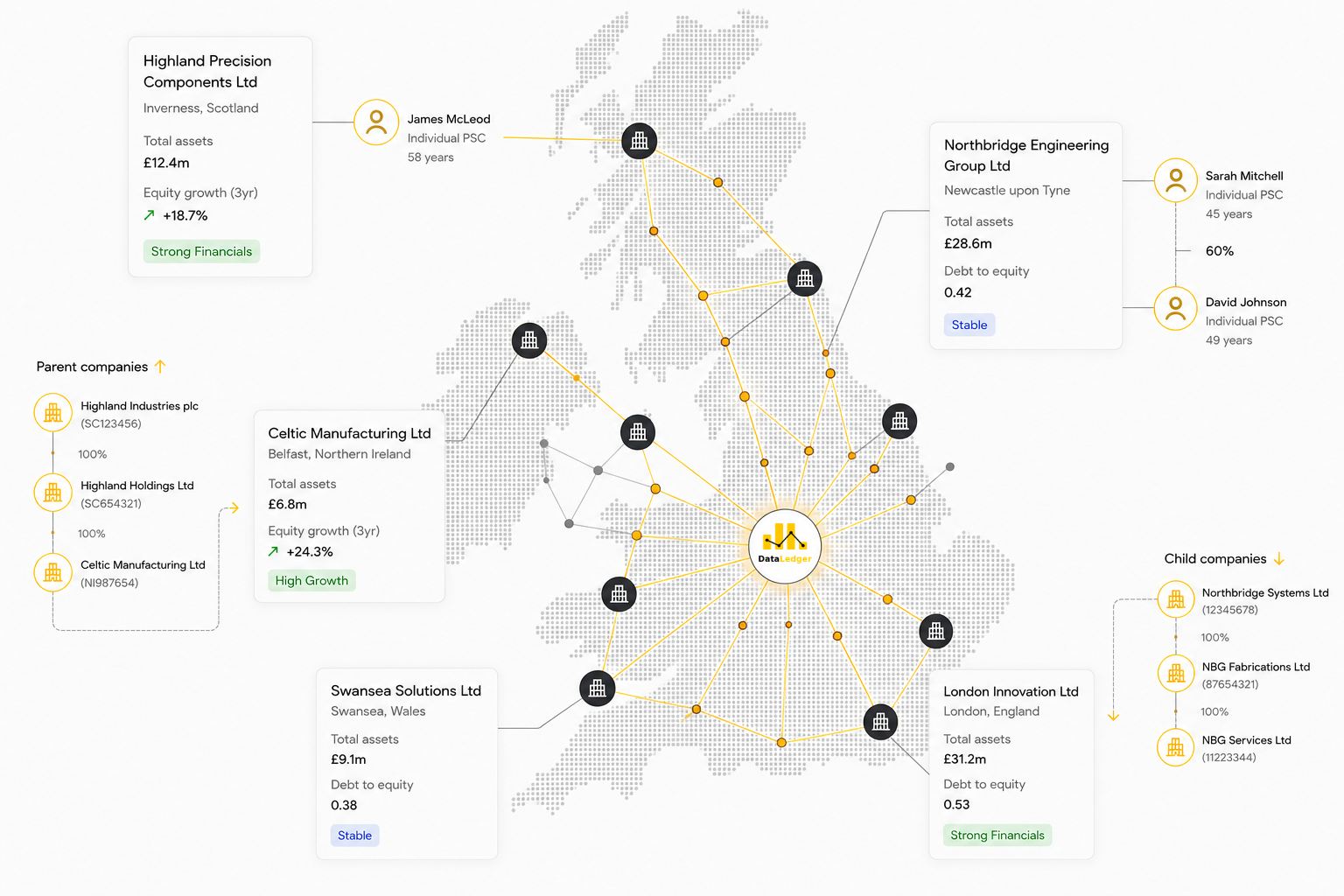
Get the right UK company data
No more data cleaning. No more manual lookups.
Structured datasets filtered to your exact criteria - ready for Excel, your tools, or via our API.
Get the right companies, not just more data
Stop clicking through individual Companies House records or wrestling with basic search filters that don't match real business criteria.
Without DataLedger
- Hours clicking through Companies House records
- Basic filters that don't match business criteria
- Manual data cleaning and formatting
- Inconsistent data quality across sources
- No financial ratios or growth indicators
With DataLedger
- Pre-filtered datasets by industry, size, and financials
- Real business criteria: growth, employee counts, assets
- Analysis-ready Excel files, no cleaning needed
- Consistent structure with data quality flags
- Pre-calculated ratios and year-on-year changes
What you get
Comprehensive financial and company data, structured for immediate analysis.
Balance Sheet Data
- Current and previous year figures
- Total assets, liabilities, equity
- Fixed assets and current assets
- Year-on-year change calculations
Financial Ratios
- Debt-to-equity and debt-to-asset ratios
- Asset growth rates
- Net asset growth rates
- Data quality verification flags
Company Metadata
- Industry classification (SIC codes)
- Employee counts
- Registered address and postcode
- Incorporation dates and filing status
P&L Data (Where Disclosed)
- Turnover and profit figures
- Most UK SMEs don't publish this
- Balance sheets more reliable
- Included where required to disclose
Save hours of manual research
DataLedger delivers structured datasets you can use immediately - so your time goes into decisions, not data cleaning.
Download Pre-built Datasets
Excel files covering common industry and size criteria, refreshed monthly. Open, filter, and start qualifying opportunities straight away.
Browse datasetsRequest Custom Datasets
Specify your exact filtering requirements - we build it, you receive it as Excel or CSV, ready to use.
Request datasetIntegrate via API
Access 3.7+ million UK companies through our JSON API. Filter by financial ratios, growth indicators, company metadata, and more.
View API docsWho uses DataLedger
From sales teams to developers, professionals across industries rely on our structured data.
Sales & Business Development
Qualifying prospects by financial health, growth trajectory, and operational scale before investing time in outreach.
Recruiters
Identifying companies with expansion indicators - asset growth, employee counts, financial stability - to target firms likely hiring.
Investors & Private Equity
Screening UK companies without relying on turnover disclosure, using balance sheet analysis for financial position assessment.
Analysts & Researchers
Comparing companies across sectors with consistent, structured data that works in Excel or their own analysis tools.
Software Developers
Embedding UK company financial intelligence into products without building Companies House infrastructure.
Three ways to access DataLedger
Choose the access method that fits your workflow.
Pre-Built Datasets
Industry-specific Excel files covering software & technology, financial services, and professional services companies.
per dataset
- Updated monthly
- Instant download
- Excel format
- Commercial use licence
Custom Datasets
Filtered to your exact specifications - employee ranges, financial thresholds, growth indicators, geographic targeting.
depending on complexity
- Delivered in 24-48 hours
- Excel or CSV format
- Any filtering criteria
- Commercial use licence
API Access
Real-time access to 3.7+ million UK companies with advanced filtering, financial ratios, and growth indicators.
/month for regular access
- JSON format
- Real-time data
- Enterprise plans available
- Integration support
Make decisions with confidence
Work from consistently structured, up-to-date company data you can trust - so you can stand behind your analysis, internally and externally.
Electronic Filings Only
We process electronically submitted UK company accounts, covering most SMEs, growth companies, and digitally native businesses.
Balance Sheet-Led Analysis
Every company includes balance sheet data. This is the only financial data most UK companies are required to publish, and often the most reliable indicator of financial position.
Verification & Quality Flags
Every dataset includes indicators showing which figures passed our balance sheet validation, so you know what's reliable.
Commercial Reuse Licence
Use the data in your business operations, share with your team, integrate into your tools. No restrictions on commercial use.
Frequently Asked Questions
-
DataLedger is a UK company data provider that transforms Companies House filings into structured, analysis-ready datasets and an API.
We focus on balance-sheet-led financial data, company metadata, and year-on-year change, rather than relying solely on revenue or profit figures.
-
All DataLedger data is sourced from Companies House and ONS open sourced data.
We process electronically submitted UK company accounts only, converting raw filings into structured, queryable data.
-
DataLedger covers all active UK companies that submit accounts electronically.
If a company files accounts electronically at Companies House and is active, it is included in the dataset.
-
Yes. Every company in the DataLedger dataset includes balance sheet data.
Under UK law, all companies that file accounts must submit a balance sheet, regardless of size.
-
No.
Only companies that are required to disclose profit and loss information include it in their filings.
Most UK companies (for example, micro-entities and small companies) do not publish turnover or profit figures.Where profit and loss data is disclosed, DataLedger includes it.
-
Yes, our paid plans include a licence for commercial reuse of the data.
-
UK reporting rules allow smaller companies to file abbreviated accounts that exclude income statements.
This is legal, normal, and widespread across the UK corporate population.
-
Balance sheets still show:
Assets and liabilities
Equity and financial buffers
Leverage and capital structure
Year-on-year change
For many use cases, these are more reliable indicators of financial position and resilience than reported revenue alone.
Common Use Cases
-
SME Credit Assessment Using Electronic Filing Data
Access structured balance sheet and P&L data from UK companies that file electronically with Companies House. DataLedger provides pre-calculated financial ratios and growth metrics for SME credit assessment and portfolio analysis.
Key use cases:
Debt ratio analysis: Use pre-calculated debt-to-equity and debt-to-asset ratios for credit risk assessment
Asset growth monitoring: Track year-on-year asset growth and net asset growth rates to identify expanding businesses
SME portfolio screening: Filter companies by equity levels, total assets, and liability thresholds for targeted lending
Financial health tracking: Monitor changes in key ratios across your client base using verified data
Available financial metrics:
Debt-to-equity ratios (current and previous year)
Debt-to-asset ratios (current and previous year)
Asset growth rates (year-on-year percentage change)
Net asset growth rates (year-on-year percentage change)
Complete balance sheet line items (when using detailed API calls)
P&L data including turnover and profit/loss (where companies file full accounts)
Data coverage: Electronic filings only - excludes large corporates that file on paper, but covers the growing SME and digitally-native business segment.
Technical implementation: REST API with financial ratio filters, bulk company screening, data quality indicators.
Progressive SME lenders are using structured electronic filing data for faster credit decisions. Still manually processing company accounts whilst competitors leverage structured data?
-
Skip Building Companies House Infrastructure - Use Our API Instead
Avoid the cost and complexity of building your own Companies House data pipeline. DataLedger provides ready-to-use structured financial data via API, eliminating months of development work and ongoing infrastructure costs.
Key benefits:
Avoid infrastructure costs: No need to build ETL pipelines, data storage, or processing systems for Companies House filings
Reduce engineering overhead: Skip months of development work parsing XBRL files and handling data quality issues
Enhanced product offering: Provide users with debt ratios, growth metrics, and financial analysis without building the calculation engine
Faster time-to-market: Integrate financial intelligence features in days, not months
Ongoing maintenance savings: No need to monitor Companies House API changes or handle data format updates
Implementation advantages:
On-demand data access: Call our API as needed rather than storing and maintaining your own database
Pre-calculated financial ratios: Get debt-to-equity, debt-to-asset, and growth rates without building calculation logic
Quality-assured data: Verified financial metrics (cVerified, pVerified) eliminate data validation work
Structured JSON responses: Clean, consistent data format perfect for AI/ML applications
Scalable pricing: Credit-based model grows with your usage without fixed infrastructure costs
Product enhancement opportunities:
Intelligent onboarding: Auto-populate company profiles reducing user data entry by 90%
AI-powered insights: Feed structured financial data into LLMs for custom report generation
Risk scoring features: Embed pre-calculated financial health indicators into your platform
Competitive analysis tools: Provide users with industry benchmarking using our sector data
Lead qualification enhancement: Enrich CRM records with growth indicators and financial stability scores
Technical implementation: RESTful API with comprehensive documentation and integration examples. Credit-based pricing eliminates upfront infrastructure investment.
Leading software platforms are focusing on their core product whilst leveraging DataLedger for financial intelligence. Still building Companies House infrastructure whilst competitors ship features faster?
-
SME Market Research & Industry Analysis
Access structured financial data for comprehensive market research and industry analysis. DataLedger provides detailed balance sheet and P&L data for evidence-based market insights and competitive intelligence.
Key use cases:
Market sizing and segmentation: Use financial filters to calculate total addressable market by revenue, assets, or geographic region
Industry trend analysis: Track sector performance using growth rates, debt ratios, and financial health indicators across SIC codes
Competitive benchmarking: Analyse competitor financial performance using balance sheet and P&L data
Economic impact assessment: Monitor SME sector health through asset growth and financial stability metrics
Research report development: Generate data-driven insights using comprehensive electronic filing database
Available analytical capabilities:
Financial health analysis using debt-to-equity and debt-to-asset ratios
Growth trend identification through asset growth and net asset growth rates
Sector performance comparison
Geographic market analysis using postcode and local authority data
Employee count analysis for workforce and operational insights
Data coverage: Electronic filing companies - comprehensive coverage of SMEs, growth companies, and digitally-native businesses.
Technical implementation: Bulk data export, advanced filtering APIs, statistical analysis capabilities, and geographic segmentation tools.
Leading market research firms are using structured electronic filing data for comprehensive industry analysis. Still relying on surveys and estimates whilst comprehensive financial data provides definitive market insights?
-
Advisory Services Using Structured Financial Data
DataLedger provides structured balance sheet and P&L analysis for modern advisory services.
Key use cases:
Growth company identification: Use asset growth rates to identify expanding businesses for advisory services
EIS qualifying company analysis: Filter by equity levels, employee counts, and growth indicators for EIS investment advice
Client benchmarking: Compare client debt-to-equity ratios and growth metrics against sector peers
Financial health monitoring: Track year-on-year balance sheet changes for existing advisory clients
Tech sector focus: Electronic filers include many SaaS, consulting, and digital businesses
Available analysis capabilities:
Pre-calculated debt-to-equity and debt-to-asset ratios for financial health assessment
Year-on-year asset growth analysis for expansion tracking
Net asset growth monitoring for wealth creation assessment
Complete balance sheet breakdown (fixed assets, current assets, liabilities)
P&L analysis including turnover and margins (where full accounts are filed)
Employee count data for operational analysis
Data coverage: Companies filing electronically - primarily SMEs, growth companies, and tech businesses rather than traditional large corporates.
Technical implementation: API filtering by growth rates, financial ratios, and balance sheet metrics with quality assurance indicators.
Modern advisory firms are building expertise in the growing SME sector through electronic filing intelligence. Focusing only on traditional large corporates whilst the digital economy expands?
-
Growth Company Recruitment Intelligence
Target companies with demonstrated financial growth using structured balance sheet metrics. DataLedger's electronic filing database captures dynamic businesses with expanding operations.
Key use cases:
Growth indicator targeting: Use asset growth rates to identify companies likely expanding their workforce
Financial stability screening: Filter prospects by debt-to-equity ratios to focus on financially stable potential clients
Expansion tracking: Monitor year-on-year asset growth and employee count changes for hiring predictions
Sector specialisation: Electronic filers include many tech, consulting, and digital businesses with active recruitment needs
Prospect qualification: Focus outreach on companies with positive financial indicators
Available growth indicators:
Year-on-year asset growth rates (companies expanding their asset base)
Net asset growth tracking (business expansion indicator)
Employee count filtering (direct hiring indicator)
Debt-to-equity analysis for financial stability assessment
Incorporation date filtering to identify new, potentially expanding businesses
SIC code targeting for sector-specific recruitment focus
Data coverage: Electronic filing companies only - excludes traditional large corporates but captures the dynamic SME and growth company segment.
Technical implementation: API filtering by employee ranges, growth rate thresholds, financial stability metrics, and incorporation dates.
Leading recruitment agencies are using financial growth indicators to identify hiring opportunities before competitors. Still cold-calling randomly whilst growth data shows exactly which companies are expanding?
-
Data-Driven Prospect Identification & Lead Qualification
Transform your business development approach using structured financial intelligence. DataLedger provides the data needed for targeted prospecting, lead scoring, and sales pipeline development.
Key use cases:
Prospect qualification: Filter potential clients by financial health indicators and growth metrics
Lead scoring and prioritisation: Rank prospects using debt-to-equity ratios, asset growth, and financial stability
Target market identification: Identify high-value prospects by revenue, assets, and employee count thresholds
Sales territory planning: Analyse prospect density and financial profiles across geographic regions
Pipeline development: Build targeted prospect lists using industry, size, and growth criteria
Available targeting capabilities:
Financial health scoring using pre-calculated debt and asset ratios
Growth company identification through asset growth and net asset growth rates
Size-based targeting by revenue, assets, and employee count
Geographic targeting using postcode and local authority filters
Industry-specific prospecting across detailed SIC code classifications
New business identification using incorporation date filtering
Data coverage: Electronic filing companies - ideal for targeting SMEs, growth companies, and tech businesses that often have higher technology adoption rates.
Technical implementation: Advanced search APIs, prospect list generation, growth indicator filtering, and CRM integration capabilities.
Top-performing business development teams are using financial intelligence for targeted prospecting. Still working from basic company directories whilst structured data reveals the best prospects?
Supported by